Wednesday, 5 November 2014

Imambara Zadibal and its Persecution


Imambara Zadibal- Symbol of ‘Satyamev Jayate’( Truth Prevails)
By Prof.Mazhar Naqvi

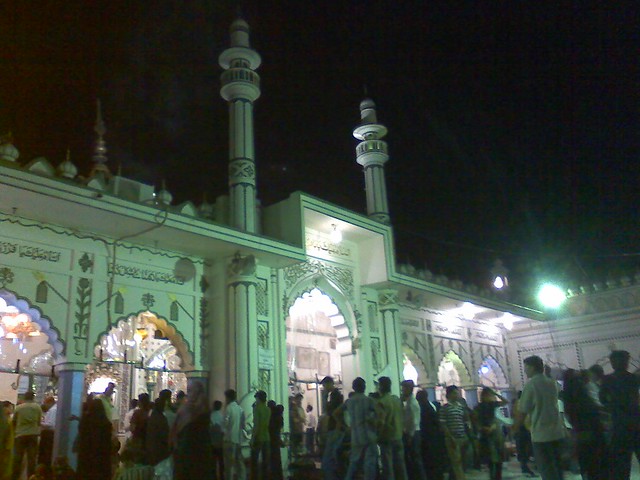
image of imambara Zadibal
Image result for imambada zadibal srinagar photosImambara Zadibal in Kashmir is probably the first and most persecuted shrine dedicated to martyrs of Karbala .A study of its history exemplify as to how it braved the test of times to emerge as a true symbol of  ‘Satyamev Jayate’( Truth Prevails). Located in Zadibal area of Srinagar, the capital of Jammu and Kashmir (J&K) state, the Imambara has witnessed many attacks by intolerance and oppressive forces like the shrine of Imam Husain at Karbala. Its history, therefore, carries horrifying tales of destruction, plunder and loot and makes it unique among all the imambaras. Founded in 1518 by Kaji Chak, who held the post of minister in the army of Sultan Mohammad, the imambara was destroyed and set ablaze several times by fanatic and disruptive elements but the followers of Prophet Hazrat Muhammad and his household (Ahle-Bait) always re-erected it with renewed enthusiasm. The Imambara not only managed to surface from rubble and ashes as an impressive edifice after destruction but also continued to serve as center for observance of Muharram rituals.
Historians have recorded the desecration of the Imambara by fire on eleven occasions between 1548 AD and 1872 AD. Communal intolerance prompted Mirza Haider Kashgari Douglat set the Imambara Zadibal on fire for the first time during the reign of Sultan Nazuk Shah in 1548.Three years later in 1551, Zafar Kupawari set it afire at the behest of the enemies of Ahle-Bait. Even during the otherwise peaceful regime of Mughal emperor  Shah Jahan, the imambara was not spared and burnt down again in 1635 by the supporters of ‘Yazidi school of Islamic doctrines’.
In 1682 AD, the Imambara Zadibal was set on fire again during the rule of Emperor Aurangzeb. Its fifth destruction occurred in 1719 AD when the Mukhtawi Khan conflict swayed the Kashmir Valley. Unknown raiders burnt it for  6th time  in 1748 AD and then again anti- Hussaini forces  set the Imambara on fire in 1763.During the Afghan rule, the Imambara witnessed its destruction by fire  on June 14,1801 on ‘Shabe- Ashura’ (the eve of Yauma-E-Ashura-10th day of Muharram).
The Imambara faced destruction on July 29, 1830 once again. The assailants also once again remained unidentified. This destruction surprise many a historians even today as this unfortunate incident not only took place during the regime of non- Muslim  Sikhs but a large number of Hussaini admirers were also brutally massacred in Zadibal for the first time after the destruction of Imambara.
At this crucial juncture, Hakim Mehndi Ali Khan, the powerful minister of king Naseer-Ud-deen Haider of Lucknow, came forwa4rd for the reconstruction of Imambara. He transferred adequate funds to Haji Baqar Khan Irani for the purpose who entrusted Hatim Mir with the responsibility of re-erecting Imambara with grandeur. Frustrated over the reemergence of imambara as a center of azadari, separatist forces once again set it on fire during the rule of Dogra King Ranbeer Singh in 1872.Hurt over the incident, the Dogra ruler doled out Rs. 3 Lakh from state exchequer for the reconstruction of Imambara.
Since then, Imambara has remained safe from the enemies of Ahle-Bait. The State Government ensures its safety not only during Muharram but also throughout the year. It is no longer considered to be just a shrine but also one of the major tourist attractions. In 2004, decision was taken to give a facelift to the Imambara on the pattern of Persian architecture. Considering the religious and archeological significance of  Imambara, the government also spent Rs. 9 crores for beautification and enlarging the complex to accommodate 32000 devotees at a time.
Thus, the imambara has showed to the world the unyielding stand taken by Imam Husain in Karbala that resulted in the victory of good over the evil. The re- erection of Imambara at a much larger scale after eleven destructions and massacre has only strengthened the eloquent message of Imam Husain that has melted the hearts and minds of countless people with sorrow for the past 1376 years. The Imambara offers sense of hope to all those who are suffering persecution anywhere in the world. Its history and edifice gives just one message that injustice and oppression can’t last forever and truth surely prevails after outsmarting all hurdles and persecution.
Image result for imambada zadibal srinagar photosMajlis-e-aza organized especially during the month of moharram

Tuesday, 4 November 2014

Hazrat Abbas Dargah-Lucknow


History of Dargah Hazrat Abbas-Lucknow
By Prof.Mazhar Naqvi
Dargah (shrine) Hazrat Abbas is the oldest and most popular among the shrines built in Lucknow in memory of martyrs of Karbala. Like most of other holy shrines in Lucknow, this Dargah was not built by any ruler or his noblemen. Rather, a non- affluent devotee of Imam Husain, one Mirza Faqir Beg founded it.  Dedicated to Hazrat Abbas, who is revered by Muslims for his loyalty to Imam Husain and his matchless efforts to fetch water for children at the battle of Karbala, the history of dargah dates back to the period of Nawab Asaf-Ud-Daula who ruled Awadh from 1775 to 1797.During his regime Mirza returned to Lucknow with a holy relic from Karbala.
About the relic, he said that Hazrat Abbas, Imam Husain’s brother and ‘Alamdar’(commander) of his small force at Karbala in a dream had helped him unearth the rectal crest that had surmounted his ‘Alam’( Standard) of ‘Abbas on 10th of Muharram at the battle of Karbala in Iraq in 680 A.D. He placed the crest at his home in Rustam Nagar. Soon the news about the crest spread and people began visiting his place with offerings and prayers for the fulfillment of their wishes, for Abbas is known as Babul- Murad (Gateway to fulfillment of wishes).
(Impressive Entrance of Dargah Hazrat Abbas- Rustam Nagar ,Lucknow with signs of Awadh style of architecture developed during Nawabi era)
 The building at first consisted of four bare walls, an unadorned roof, and a small courtyard. The growing popularity of the relic earned the attention of  Asaf- Ud-Daula..He visited the place and ordered that a dome be erected over the place to convert it into a Dargah .The place became popular among those  in search of healing, sons, and spiritual blessings, and flower and sweets merchants began doing a booming trade in front of the gate. A turning point came when Nawab Sadat ‘Ali Khan fell seriously ill about 1801.He vowed to construct a magnificent new building for the shrine should he recover. Nawab got rid of his ailment in 1803.He visited shrine with his courtiers after taking out magnificent procession.He distributed money all along the way to the thronging multitudes lining the streets. At Dargah, he offered prayer of thanksgiving. Then, he ordered for the construction of a new edifice with an impressive gilded dome. He established a fund to cover the shrine's expenses, and people began gathering there regularly on Thursday evenings. He also built two separate enclosures for male and female visitors to the shrine.

His successor and son, Ghazi-ud-din Haider, who was crowned as the first King of Awadh in October 1819 by British, provided a Naubat Khana at the entrance of Dargah in the form of a double storied gateway. Naqqara (large drums) were sounded from the upper storey  to inform the hour of the day as well as announce the arrival  guests of the royal household on their visit to the shrine. The King also provided the inner sanctum where the iconic alam was preserved with silver foiled doors.
 Naseer-ud-Deen Haider succeeded Ghazi –Ud-deen Haider as the second King of Awadh (1827-1837).His favorite queen Malika Zamani started a permanent kitchen for free distribution of food to the poor. She used to visit Dargah on every nauchandi jumeraat (first Thursday of each month) with an offering of ten thousand rupees. Down trodden waited eagerly for her procession consisting of a hundred elephants with silver howdah (mounted seat) and gold embellishments. It had a number of palanquins and oxen driven carriages for the accompanying ladies. The queen sat in a large ‘sukhpal’ (decorated carriage) covered with a brocade silk canopy while her companions distributed alms to the destitute with generosity.
The Dargah also played as host to the soldiers of Begum Hazrat Mahal during the first war of Indian Independence. In 1858, it served as headquarters of the anti-British forces..Shah Ahmad Ullah, perhaps the most influential leader of the freedom struggle and one of the chief commanders of Begum camped at Dargah before leaving for Bareilly where he was captured and executed. After recapturing Lucknow, the British soldiers plundered Nawabi buildings and they did not spare even Dargah. They removed gold in alam and the dome.  The British auctioned priceless jewels and decorative preserve d at Dargah along with the valuables of King Wajid Ali Shah.
The shrine even today is manifestation of popular love for the family of the Prophet and belief in the efficacy of supplicating its members. Devotees throng at Dargah in large number to invoke blessings of Hazrat Abbas to overcome their problems.

Muharram Rituals and Eunuchs


Muharram Ceremonies In Awadh and Eunuchs

By Prof.Mazhar Naqvi
History has somewhat remained biased towards the role of eunuchs in promotion of Muharram
rituals in Awadh Kingdom. It is unfortunate as their contribution to preserve the sacred memory
of the martyrs of Karbala is second to none. Historians deliberately overlooked eunuchs or fell
 prey to forgetfulness while penning down various shades of azadari during the era of
Lucknow Nawabs? This question may always shroud in mystery but grave injustice meted out
to them still remains a harsh reality and efforts should be initiated to put them on Hussainiyat’s
roll of honor.
 The court eunuchs served as an interface between the interiors of the royal harem (household) and the world that existed beyond it. As they had access to both Harem and outside world, Begums who were required to confine themselves within the harem had to avail the services of eunuchs to seek outside information and convey their instructions and advice to the officers of the durbar (court).The chief of these eunuchs was called Khwajasara. He was not only significant but often enjoyed great influence on the ruler and his queens. Some Khwajasaras even had managed to assumed power to the extent that they could manipulate matters that were placed into their confidence.
The rulers were always on the lookout of trustworthy eunuchs. Most of them came from the families of Rajput warriors captured in battles. Male youths of these families were castrated and brought up in harems. The Nawabs often entrusted their eunuchs with official duties, such as managing their owners' estates or even tax-farming entire provinces, transforming them into a mamluk (slave-ruler) substratum of the government. The slave eunuch officials accumulated vast properties that legally belonged to their masters, although they often could influence the disposition of their property.
One such Khwajasara was Mian Almas Ali Khan who served as ‘Amil” during the reign of Nawab Asaf Ud Daula. He was an able administrator and created new records in tax- collection. His efforts not only increased the state revenue but he himself amassed huge wealth. Mian Almas also commanded lot of respect from British. He was born in a Jat family but after his castration, he embraced Islam and like his master developed great affection towards the progeny of Prophet Hazrat Muhammad. Almas Khan spent generously on the construction of Imambaras and mosques. He is credited with the construction of the first Imambara of Kanpur district at Bithoor. He also erected Imambaras o n Kakori road  in Lucknow,  Etawah, Auraiya and Kora Jehanabad in Fatehpur district. The Khwajasara also developed a town Mianganj in Unnao district and dotted it with an impressive Imambara that is no longer in existence but its traces ate somewhat still visible.     
Another eunuch Jawahar Ali Khan, a faithful Khwajasara of Bahu begum, also built an Imambara at Faizabad. The imambara is known as Jawahar Ali ka Imambara and a prominent center of azadari even today. Another Khwajasara Darab ‘Ali Khan also contributed to promotion of azadari after Jawahar Ali Khan. He took care of imambara of Jawahar ‘Ali Khan after the latter died. Tahsin Ali Khan, yet another notable Khwajasara of Nawabi era of Lucknow also promoted and preserved azadari. He was supervisor of Nawab’s old harem in Faizabad and held a land grant (jagir ) in addition to large amounts of movable property. He was so attached to Asaf-ud-Daulah that on the death of the latter he left all his worldly belongings and remained at his grave as its keeper, wearing the garments of a fakir(mendicant) in mourning. The son of Asaf-ud-Daula, Wazir Ali, the next ruler, persuaded him to return to the palace. He bestowed upon him the khilat (robe of honor) and elevated him to the post of Nazir (estate superintendent) for the royal palaces. Tahsin built an imambara and a mosque in Lucknow. While mosque is still in a good condition in Chowk locality, his imambara has fallen prey to land grabbers. Afreen Ali Khan who was also attached to the royal court of Awadh also encouraged the promotion of azadari. Khwajasara Bahar Ali Khan also strived for preservation of azadari rituals in Faizabad. He even played a pivotal role when the disputes between two powerful Iranian groups emerged as a potential threat to the unity of Imam’s devotees.  
Karbala Dayanat –Ud- Daula in Lucknow is also a fine example of the reverence and love which Khwajasaras had in their hearts for Ahle-E-Bait. It was built by Dayanat-ud-Daulah, a khwajasara of Nawab Wajid AN Shah. His original name was  Mohammed Ali Khan and Dayanat-ud-Daulah was the title conferred upon him. The Karbala became the much famous in May 1854, when One Mehndi Hasan brought a unique “zarih”, (replica of imam Husain’s shrine at Karbala) specially made of khak-e-shifa (clay believed to contain curative power and  unearthed from the shrine of Imam) on his return from Karbala after stayimng there for nearly two decades. The Zarih was placed reverently Karbala Dayanat-ud-Daulah. Nawab  Wajid Ali Shah with his nobles and officials, all dressed in black (symbolizing  mourning)  visited Karbala Dayanat- Ud- Daula in a royal procession for the ‘Ziarat’ of Zarih Mubarak.
With gilded dome and Quaranic verses in excellent calligraphy on its interiors, this  Karbala is not only beautiful but also reminds that influential Khwajasaras preferred to preserve azadari by spending lavishly and they refrained from wasting money on worldly affairs, perhaps a message for all those who wish to contribute to the ongoing mission of Imam Husain against all kinds of Oppression.( Author if a Kanpur( India) based heritage expert with a desire to contribute write ups on Muharram rituals for two month eight days from the beginning of Muharram-2014).    

Monday, 3 November 2014

Hussaini Langar


Begum Hayat Bakshi-Founder of Husaini Langar
By Prof.Mazhar Naqvi
Langar (Feeding devotees and destitute) in memory of martyrs of Karbala is a significant constituent of Muharram ceremonies .Historians have however never pondered over as to who and when the custom of Hussaini’ Langar’ was started. As a result its founder Begum Hayat Bakshi simply remains as one of the most influential lady of Golconda kingdom. She was the only child of Mohammad Quli Qutb Shah, the founder of Hyderabad. She looked after the palace administration early as daughter, then wife and ultimately as Queen Mother during the regime  of three Qutub Shahi kings.
Like her father, she had ardent love for Imam Husain in her heart. Being a true follower of Ahle-E-Bait she was compassionate, generous and considerate towards the needy.  Her subjects addressed her as ‘Ma Sahiba’ out of reverence. How she became founder of ‘Hussaini Langer’ is linked with the fulfillment of her’ Mannat’(wish) for the safety of her only son Abdulla?. He was impulsive and hot headed by nature.Opnce he wished to ride ‘Murat’ a favorite elephant of his emperor father Sultan Mohammad.
The tusker was in a foul mood that day. His attendants warned him not to ride Murat ,the animal being in a state of  ‘Masti’. Abdulla  did not pay any heed to his retinue and rode the elephant he commenced his ride from the royal stables located in Hussaini Alam area .Upon reaching the bank of river Musi ,Murat turned uncontrollable. The Mahout  tried his best to persuade Murat to cross the bridge.He miserably failed in his bid as the swollen river and the roar of flood water  startled Murat.The furious elephant knocked down the Mahaout , trampled few other persons and entered  the nearby  forest with Abdullah. Upon coming to know about the incident, Begum  rushed troops but no trace of Murat and its royal rider could be found for next three days. She even made provisions with the help of her subjects  by hanging bags containing  water and food with branches of trees so that Abdulla could grab one of them if Murat happened to pass close to any such tree. As hapless mother awaited her son, the Muharram moon was sighted.  The distraught mother  prayed to  Imam Husain and took pledge to  present her missing son bound in chains at the doorsteps of the Hussaini Alam Ashurkhana if he returned  safety.
Her vow evoked positive result as Abdulla miraculously arrived at the gate of fort much  to the delight of his  grieving mother. Begum  however  forbade his entry into the palace until the honoring of her pledge. She summoned all the goldsmiths of Golkonda and asked them to prepare a gold chain( Langar) of  40 ‘maund’ weight . Then, she took her son, bound in golden chains, barefoot on the red carpet, from  fort to the Ashur Khana.

After his appearance ( Haziri) at Ashur Khana  , the golden  chain was  broken into pieces and distributed among the poor along with food and sherbet. Begum continued the tradition in the following years during muharram. Thus a tradition of feeding the poor or ‘Zaireens’(Devotees) was born. From Hyderabad, the tradition spreads to other corners and cities and distribution of food and sherbet  is considered to be an essential part of muharram Ceremonies, especially on Yaum-E-Ashura across the globe.

Saturday, 1 November 2014

Hindu 'Azadars' of Muslim Imam


By Prof.Mazhar Naqvi

The prominent participation of Hindus in observance of Muharram ceremonies(Azadari) is the most striking feature of azadari in India. .  Imam Husain’s great sacrifice is remembered across the globe but it is commemorated with matchless emotional intensity in India. Each year during Muharram, Hindus join Muslims in lamenting the martyrdom of Imam Husain, by sponsoring or taking part in rituals and tazia (replica of the mausoleum of Imam Husain in Karbala) processions.
Hindus observe Muharram ceremonies with great devotion. Varanasi, the holiest city of Hinduism, has a mixed tradition of commemorating Muharram .Varanasi’s Shivala Mohalla boasts of the most artistic tazia, and a replica of Zuljinah( Imam Hussein’s brave horse}.Devotees form bee line to offer milk and Jalebi to Zuljinah in a traditional ritual in many cities in Uttar Pradesh and Madhya Pradesh. The Hindu rulers of Vijayanagar in Deccan (southern India) built wonderful Imambaras during the 16th and 17th centuries. They even wore the black garments of mourning during the first 10 days of the month of Muharram. Muharram processions during the 18th and 19th centuries were taken out by the Hindus in Rajasthan, Gujarat and Maharashtra with rath (Hindu chariots) shaped tazias. The ex-rulers like Scindias of Gwalior, the Holkars of Indore, the Geakwads of Baroda and the Bhonsle of Kolhapur observe Muharram rituals with great devotion even till now.
In Lucknow, a large number of Hindus participate in the ‘azadari’ processions. Many Hindus fast with Muslims on Yaum-E- Ashura while others distribute sherbet (sweet juices) and iced milk to those participating in the Muharram processions. Some Hindus even walk on fire with  chants of ‘Ya Husain’ on their lips. Lucknow  presents an unparalleled example of Hindu-Muslim unity in this historical city.
Hindus run several ‘anjumans’ (religious organizations) in Lucknow and  take out ‘azadari’ processions and organize ‘majlis’ (mourning sessions where heart-rending tales of Imam Husain’s martyrdom are narrated) throughout Muharram.
Lucknow also boasts of several Hindu ‘imambaras’ (mausoleums). One such is the ‘Kishnu Khalifa ka Imambara’ in Bashiratganj locality in the old city area. The Imambara, established in 1880, is famous for its Hindu ‘azadars’ (devotees). ‘Anjuman-e-Hind-e-Abbasia’ and ‘Anjuman Haaye Sakeena’ are outfits famous  for participation of Hindus in large number  in all the mourning rites associated with Muharram in large numbers.
The Sharma Hindu families have been taking out the Tazia procession on Muharram for more than 120 years in some districts of Madhya Pradesh. The ritual began in 1882 when the Raikwar family of the Vidisha town began preparing and taking out Tazias on the ninth day of Muharram. Since then, the Raikwar’s Tazia leads the procession of mourners on Muharram. Like several Muslim families , the Raikwar family members, too, set aside their daily chores to grieve for the grandson of Prophet Muhammad, Imam Husain (A.S.), and his 72 companions who were brutally killed on the banks of the river Euphrates in Karbala (Iraq) in 61 A.H. In  Sehore, another Madhya Pradesh town , Hindu family has been taking  tazia procession for more than 100 years.
Leading English daily “The Hindu” had  reported in its edition dated  31 January, 2007  that a large number of Hindus participated in the `Tazia’ procession along with Muslims at Pulimankulam in Tamil Nadu . The procession was led by V. Nayaz Ahmed Bijili and H. Habeebur Rahman Bijili, hereditary trustees of the Athangarai Pallivasal Dargah. Hindus from Sokkalingapuram, Urumankulam, Tiruvamabalapuram and Avudayalpuram, marched towards the `chavadi’, where the `Panjas’ were installed, and offered prayers. Two hindus even performed firework ( AAg Ka Matam).One of them Mr. Veerabahu, has been doing Aag ka Matam for the past 30 years.

In Kahmir, a Brahmin tribe ‘ Mohiyals’ takes part in Muharram observance with great devotion and fervor. They believe that their ancestors had   fought with Imam Husayn (A.S.) and avenged his  killing by uprooting  the Umayyads. Later, they believe to have traveled back to settle in Kashmir via Afghanistan.
Even in Orrisa, hundreds of Hindus joined Muslims in observing Muharram in a village to end a 25-year-old conflict over the ownership of a burial ground. Hindus and Muslims in Peteipur village had clashed many times over 1.75 acres of land that the former wanted for a cremation ground. The Muslims wanted the plot for a Muslim graveyard. More than a hundred villagers participated in the procession on 10th Muharram  to mark the end of dispute. The State  Education Minister , who belongs to the region, and Lok Sabha member Brahamananda Panda also joined the procession.
The most interesting case of Hindu veneration of Imam Husain is to be found among the small Husaini Brahmin sect, located mostly in Punjab state in India, also known as Dutts.They believe that their ancestor named Rahab had  developed close relations with Imam Husain. In the battle of Karbala, Rahab fought with  Imam  Yazid. His sons, too, joined him, and most of them were killed. Imam Husain, seeing Rahab’s love for him, bestowed upon him the title of sultan or king, and told him to go back to India. It is because of this close bond between  Rahab and Imam Husain that they christened themselves as Husaini Brahmins..

In Andhra Pradesh and telangana, the Hindus  observe Muharram every year with great devotion and surpass the enthusiasm of their north Indian counterparts . People of all castes are encouraged to participate and the caste differences so rigid among them are forgotten. They called Muharam as Deen Govind. They even practice the ceremony of becoming Fakir.On the fifth night, a procession Panje ka Pitar is taken out in Goundu Village .Another village called Solapur in Rai Durg Taluq gained prominence as a famous Telugu poet Ramanna of the village wrote number of poems describing and eulogizing Muharram. In one such poem he writes.
Padda la pandu ga rawe, Peer la pandu ga rawe (Come, the festival of the great man). The people of the Solapur village, even abstained from eating meat during the Muharram days. Surapalli is yet another village where a large number of people assemble to observe  Muharram . Balaiah, a poet of the village , used to write  poems in praise of Imam and his companions and recite them every day to a large audience during Muharam. One of his  poems starts with these lines “Allah ke namanu anara,devata la devama vachurao (Recite in the name of Allah, Devata will bless you)”.It is interesting to note that even telgu women  wrote poems to pay their homage to the martyrs of Karbala. Three such women, who gained prominence were  Imam Aka, Vanoor Bee, and Gateema. Vanoor Bee in one of her poems gave us the reasons for her devotion. She wrote” if you speak truth Bibi Fatima will bless.”There are even Telugu folk songs written to pay homage to the martyrs of Karbala.

Muharram ceremonies in India have served served to unite the Muslims in India as well as bring the non-Muslims closer to them. The Taziya, Alams and Mehndi attract the attention and devotion of Hindus and are very popular among them. They visit the Taziyas for darshan (homage) and make mannats (vows) and give offerings. In India the Muslims and Hindus are united in seeking solutions through the Taziyas. Apart from the Taziyas, the Muharram ceremonies always increase inter-communal interaction.